
On-Demand Recording
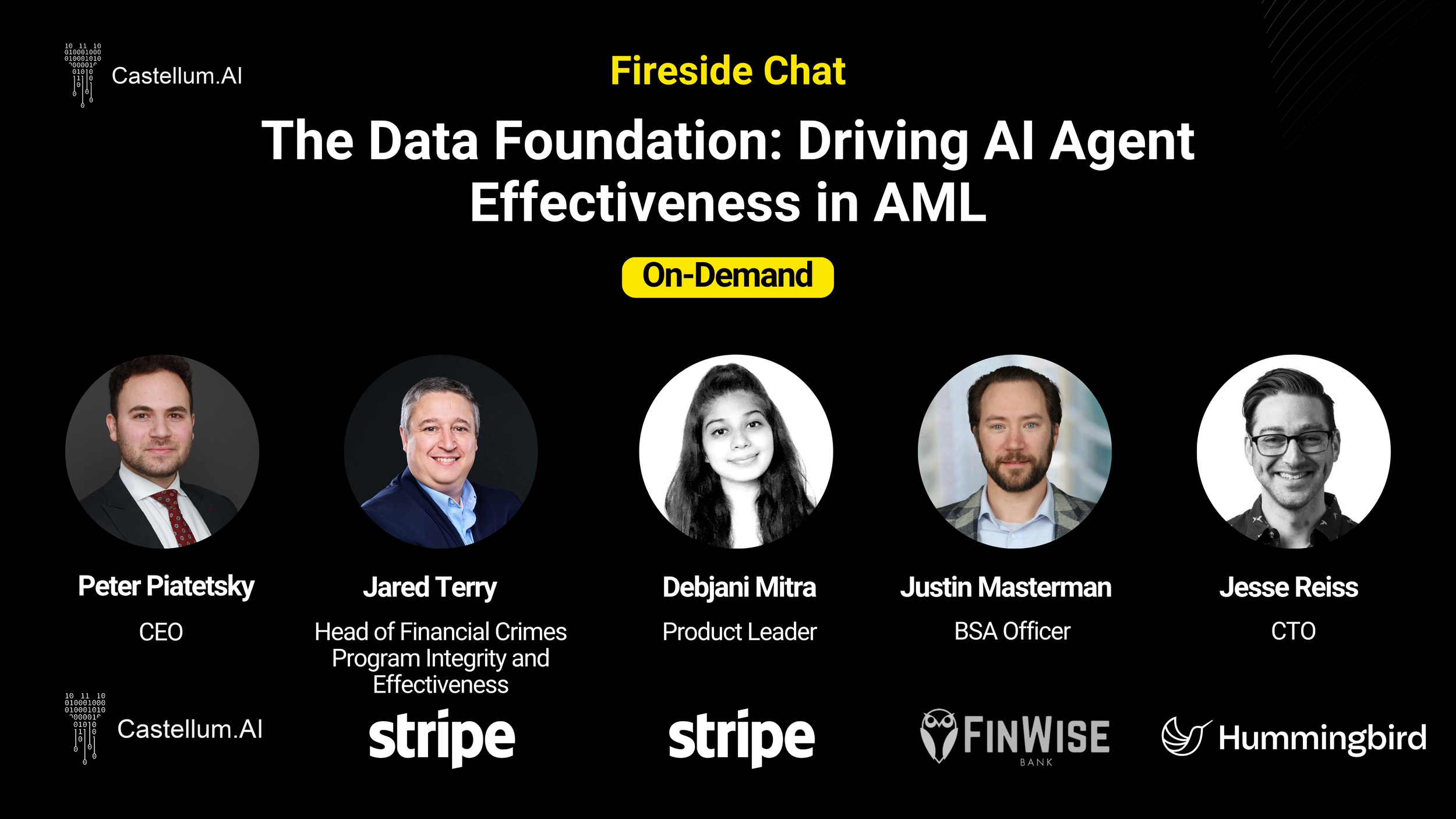
The Data Foundation Driving Effective AI Agents in AML
AI agents are only as good as the data they run on — yet most discussions about AI in AML skip past the data layer entirely. In this session, compliance practitioners and AI implementation experts examine the foundational data requirements that determine whether agentic AI delivers on its promise.
How data accuracy, completeness, and structure determine what agentic AI can and cannot do in AML workflows
Where data gaps silently degrade alert quality and risk decisioning
How AI agents consume and interpret data context at the point of decision
How to assess data readiness across customer records, transaction history, and third-party feeds
Meet the Speakers
Jared Terry
Head of Financial Crimes Program Integrity and Effectiveness
Stripe


Jared leads the Financial Crimes Program Integrity and Effectiveness function at Stripe, where his team sets the investigative standards, quality frameworks, and AI-enabled tooling strategy that enable Stripe's program to scale across sanctions and AML globally. He brings 15+ years of experience across the public, banking, consulting, and fintech sectors.
Debjani Mitra
Product Leader
Stripe

Debjani leads efforts to build AI-driven platforms for risk and financial crimes management enabling businesses to operate in the digital economy. She brings 10+ years of experience delivering products used globally by millions.
Justin Masterman
BSA Officer
FinWise Bank

Justin is an experience AML expert with experience overseeing sanctions and money laundering programs at regulated financial institutions. He also assists in AML oversight for FinWise Bank’s fintech partner network.

Jesse Reiss
CTO
Hummingbird
Jesse is CTO and co-founder of Hummingbird, an AML and financial crime compliance platform, where he oversees development of AI-enabled products to accelerate investigations.
Peter Piatetsky
CEO and Co-Founder
Castellum.AI

Peter leads strategy, growth and product at Castellum.AI, working closely with clients to implement risk-aligned solutions. Prior to co-founding Castellum.AI, Peter served at the US Treasury Department.
Featured Resource
How to Evaluate AI Agents for AML/KYC Workflows
A practical guide for teams to assess, test and implement AI agents into compliance workflows. What’s inside the guide:
True agentic AI vs. automation: How to spot real autonomy, not just workflow orchestration.
Data governance: Why ownership and control of risk data matters for safe decisioning and auditability.
Human-in-the-loop design: How to ensure the right feedback loop to improve accuracy and accountability.
Regulatory readiness: How to align AI deployment with emerging regulatory expectations.